
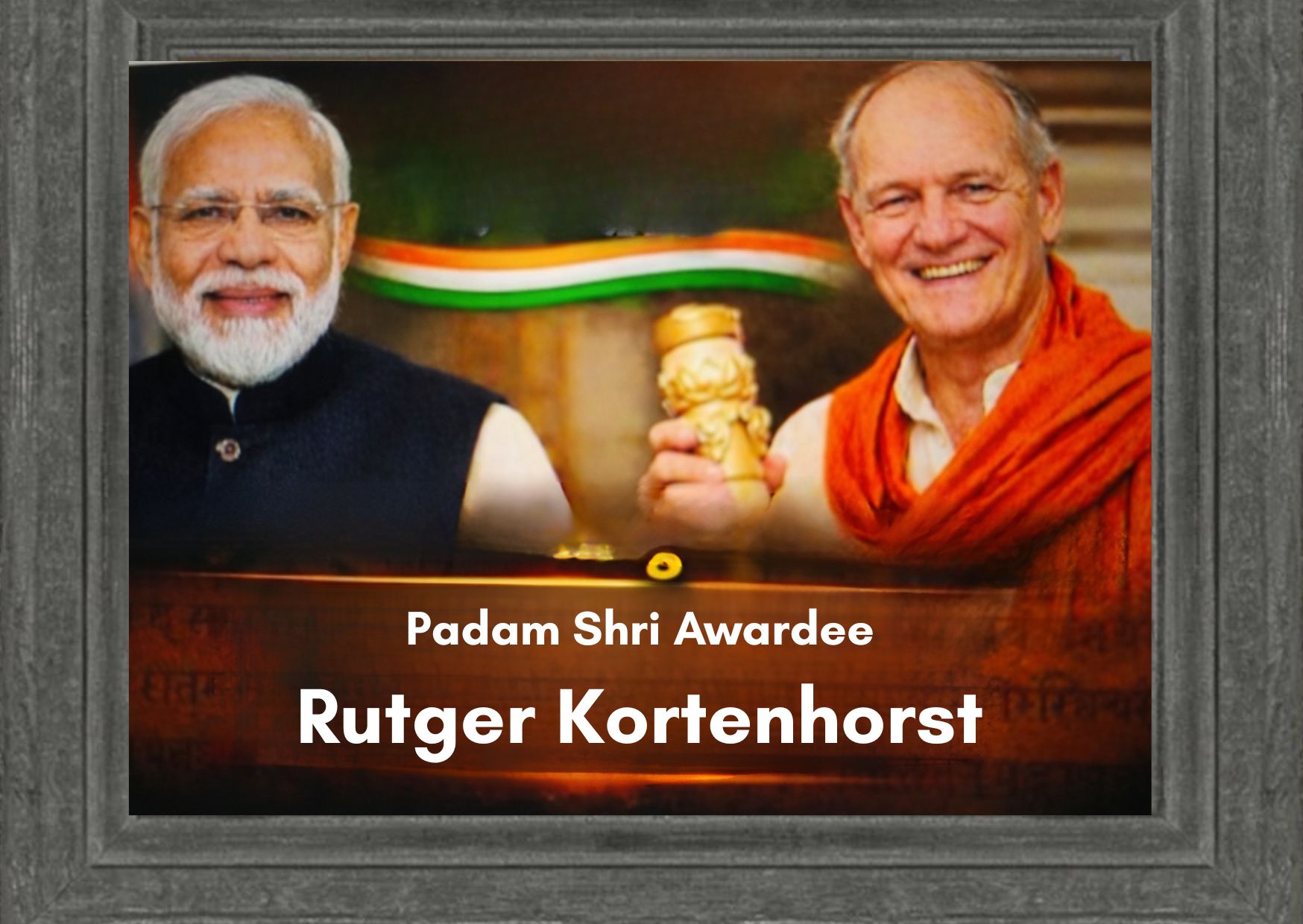
Rutger Kortenhorst: The Man promoting Sanskrit in Irish Schools
Would you believe that someone would be teaching Sanskrit passionately in a country which is more than 8000 kms from India? Difficult to digest-Right.Here goes the story!
Prime Minister-Narendra Modi talked about Rutger Kortenhorst’s passion for Sanskrit on the popular show Mann Ki Baat in August 2021. Before that, Kortenhorst’s work was mostly known in academic and cultural circles. This recognition brought him into the limelight, and he went on to receive the Padma Shri, one of India’s highest civilian honours, in the Year 2022.
Kortenhorst’s journey is amazing not only because he taught Sanskrit to people in a country other than India, but also because he came up with new ways to teach and learn the language in a modern, global setting.
A Trip from Europe to Indian Philosophy
Kortenhorst was born in the Netherlands to a Catholic family. He later moved to Dublin, Ireland, where he followed a typical European educational path. He learned discipline and classical subjects in school while in Dublin, but came across Indian thought and the Sanskrit Language in college, which transformed his entire life.
What started as an intellectual interest quickly turned into a strong desire to learn about and share the knowledge that was hidden in Sanskrit texts. He eventually decided to spend his life making it more accessible to younger people, especially those who live outside India.
He spent a lot of time in India studying Sanskrit in traditional Gurukul settings and taking part in conversational Sanskrit programs to learn more about it. This hands-on experience helped him learn how to pronounce and write correctly.
Bringing Sanskrit to John Scottus School
One of Kortenhorst’s most important contributions has been his work at John Scottus School in Dublin, where Sanskrit has been a core subject since the school opened in 1986. But his job was much more than just teaching the language. He stepped down from his job as vice-principal to focus all of his time on improving and expanding Sanskrit education in elementary schools.
Most schools in Europe focus on Latin or Greek, but John Scottus took a different approach: Rutger came up with a way of teaching that was both fun and useful:
Sanskrit was made a core language from a young age, and grammar was taught through songs and rhythmic chanting. Students were encouraged to speak and listen, not just memorise, which helped them focus, be clear, and feel more confident.
Because of this, students liked the subject so much that they casually sang the rules of Sanskrit grammar, making learning a natural and fun process. This method made Sanskrit easy to understand and useful for the young students.
He revolutionised the way Sanskrit was taught forever. He even went ahead and integrated elements of traditional Indian knowledge systems into the curriculum, including: Yoga, Ayurveda and Lessons from the Bhagavad Gita. These practices were designed to nurture-Mental clarity,Emotional balance, Discipline and self-awareness
Students at John Scottus chant verses, recite shlokas at international events, and really connect with Indian philosophy. Notably, Irish students once impressed Prime Minister Narendra Modi by reciting Sanskrit verses during his visit demonstrating their depth of learning.
Kortenhorst’s work has had a big impact on how people around the world see Sanskrit. It is now seen as a more useful language with precision and logical structure, as well as a way to improve cognitive skills and connect ancient wisdom with modern scientific thought. His work shows that Sanskrit is not just a dead language; it is a living language that can help people learn and change the future. Kortenhorst has made sure that this old tradition will live on.
The above story goes to prove that while we in India do not take pride in learning about our Culture and languages, there are people who find so much merit in propagating our very own forgotten culture and, most importantly, the language -That is, Sanskrit.